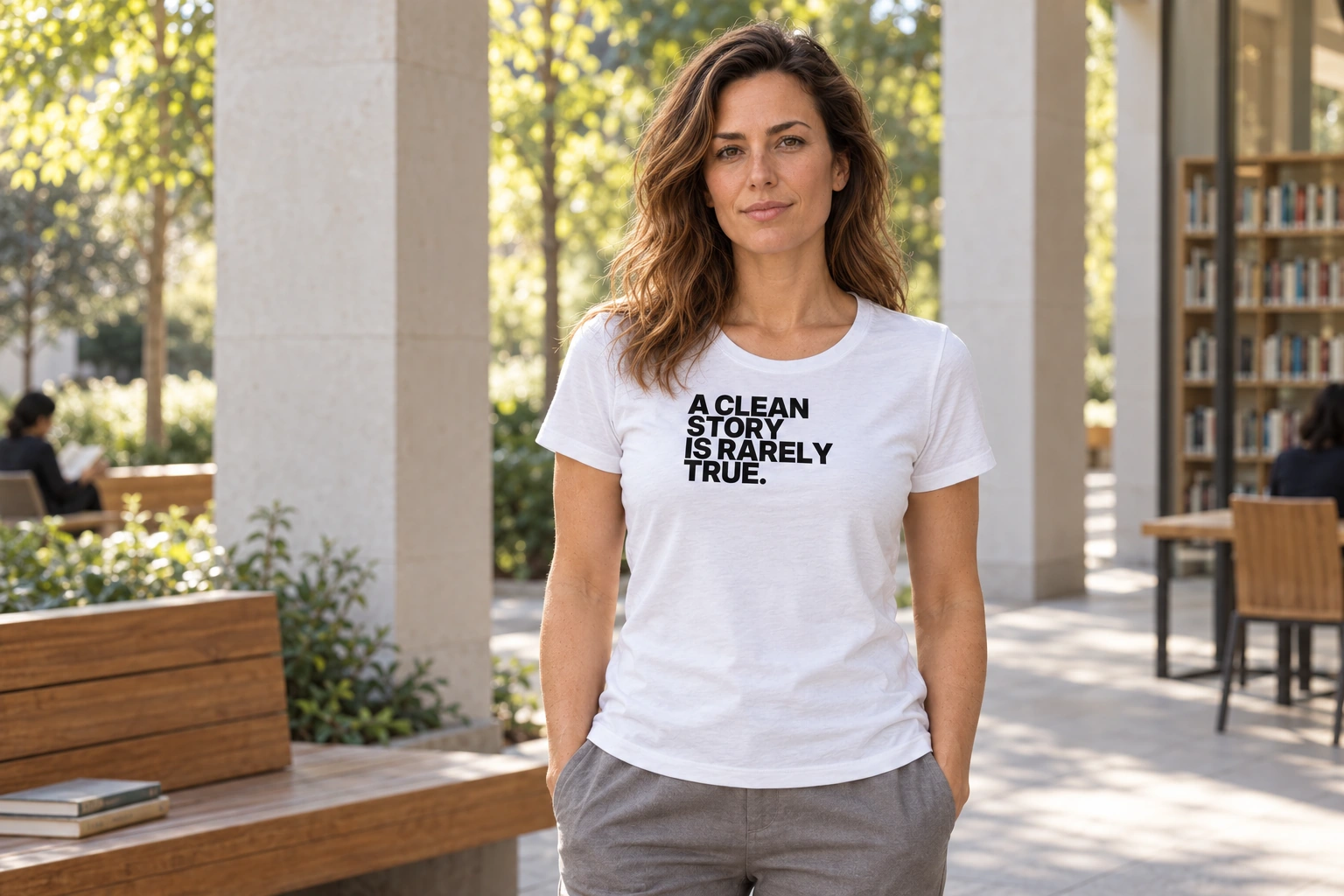
In hindsight, everything can sound perfectly logical. First came a good idea, then the right decision, then the result. Nobody hesitated, nobody wasted three days on the wrong thing, and chance played no part in the story. Very nice. I wonder where the rest of the material went.
“A clean story is rarely true.” That is where the doubt on this T-shirt begins. In a story that is too clean, everything seems to be in its proper place. Sometimes so neatly that what actually happened no longer fits.
A good editor or an overzealous cleaner
A story has to be selective. When you talk about a day, you do not need to list every time you put your coffee cup back on the table. Leaving out a few details helps the rest make sense. The question arises when the doubts, mistakes and other people’s contributions disappear along with the irrelevant bits. All that remains is a narrator who knew exactly where they were going all along.
That version is comfortable to listen to. It is even more comfortable to tell about yourself. Today’s explanation gives yesterday’s decisions a name, and suddenly even getting lost was a strategy. The word certainly sounds respectable enough.
The line on the shirt can be a small reminder to ask what was left out of the picture. Not just when listening to someone else’s story. Also when your own starts sounding exceptionally good.
Four tidy lines about messy circumstances
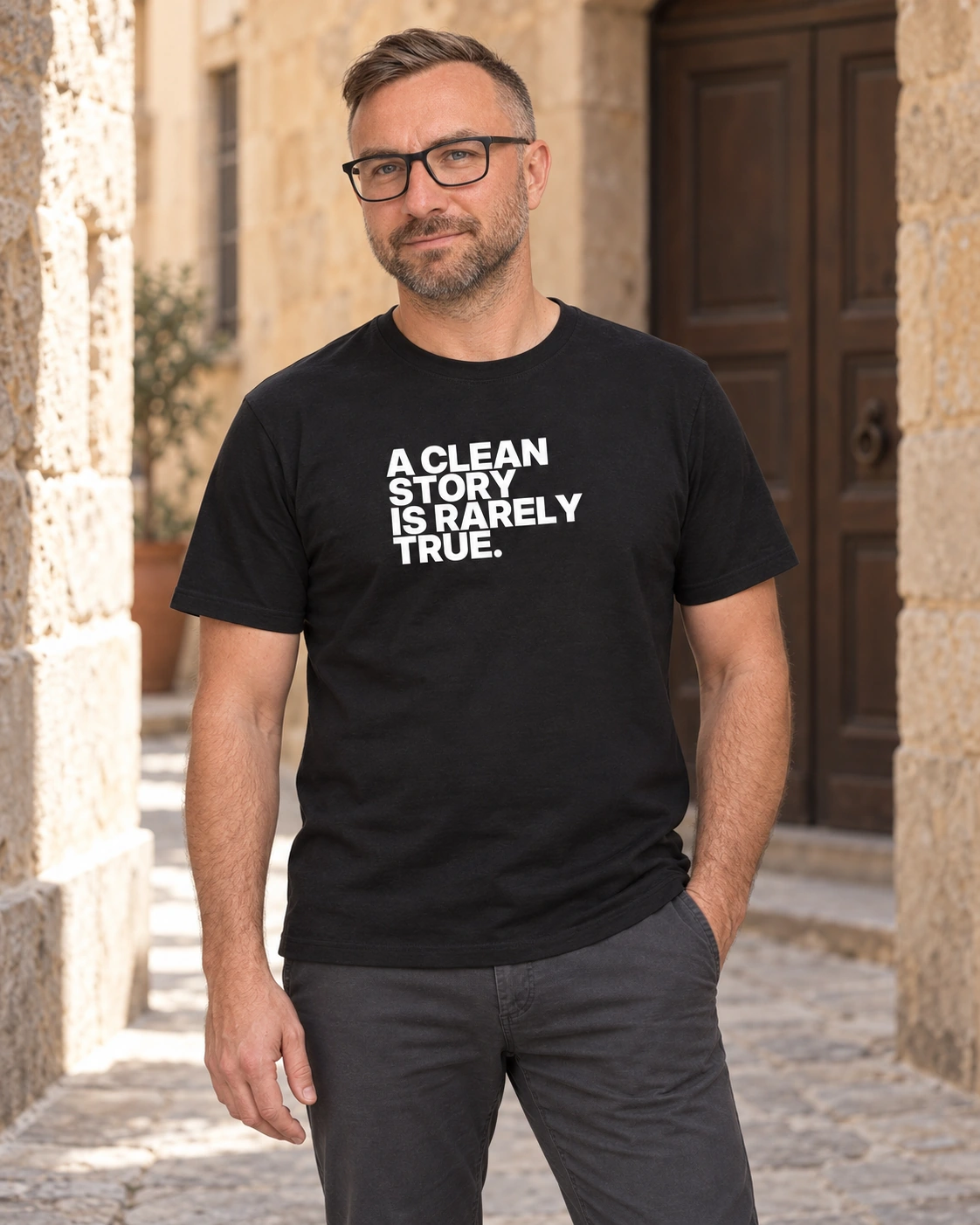
There is little confusion in the graphic itself. Bold capital letters, four tightly packed lines, a straight left edge. “A CLEAN”, “STORY”, “IS RARELY”, “TRUE.” Each part is in its place, and the final word closes the block with a full stop. The doubt is expressed with quite a bit of certainty.
That clash gives the design its character. Visually, the sentence almost looks like an instruction, while its meaning questions that very tidiness. If the words were scattered all over the shirt, the idea of confusion would be immediately visible. Here, you have to find the contradiction in the words.
The black-and-white print leaves all the attention on that small line of thought. There is no narrative illustration telling you whom to doubt. The reader brings the rest of the story.
“Rarely” leaves some room
The most important word here may be the least grand: “rarely”. The sentence does not declare everyone a liar or offer a muddled story in place of evidence. A complicated explanation can be nonsense too. You simply do not have to believe a very polished version just because it is polished.
The earlier “Seems Like a True Story” article looked at this through a familiar teller of tall tales: the opening draws you in, and the ending admits the exaggeration. “A Clean Story Is Rarely True” stops one step earlier. The story has not been disproved. There is simply one more question.
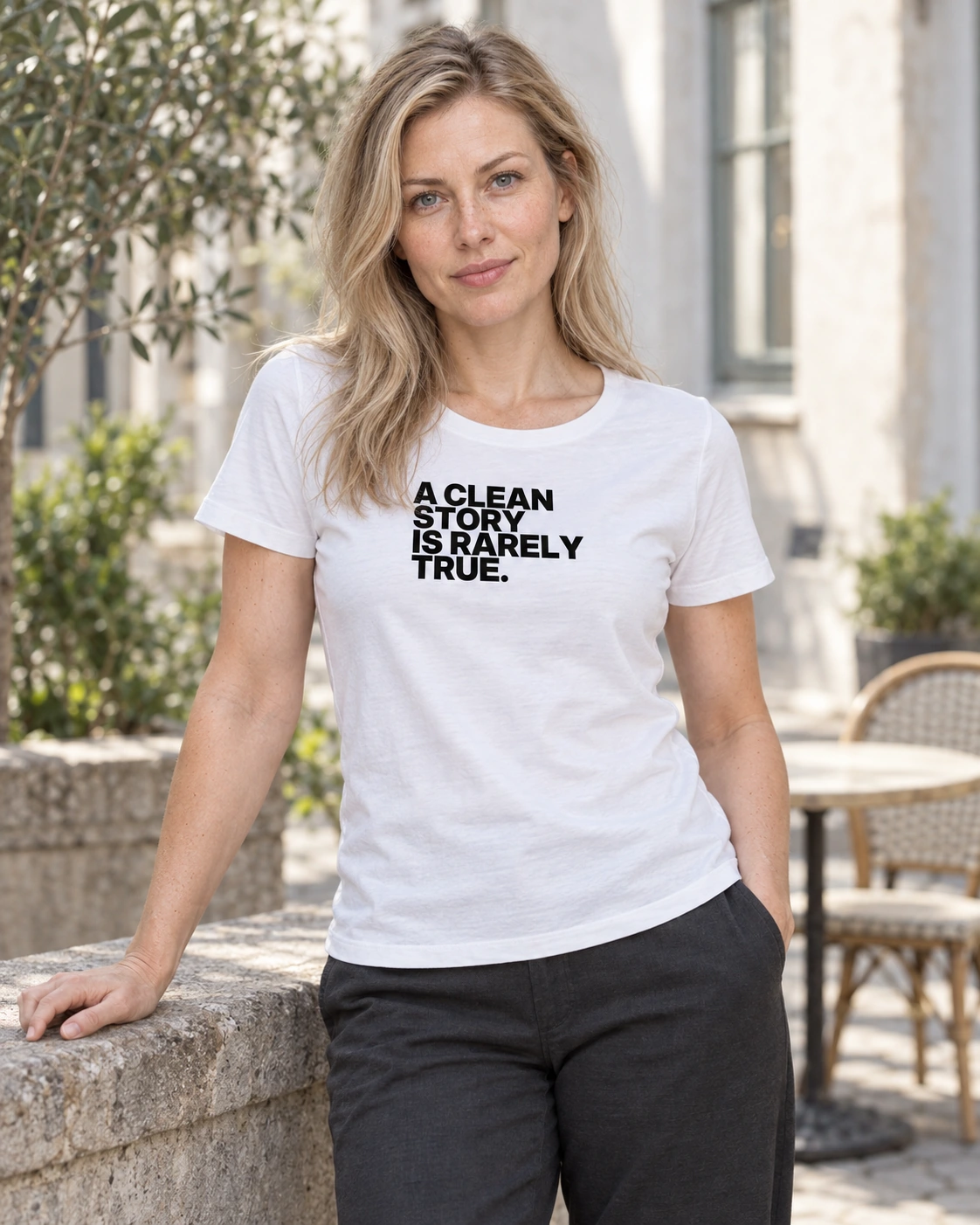
This may speak to you if fully formed explanations tend to arrive a little too early. Or if you recognise your own habit of making life sound more sensible afterwards. You can wear the shirt for that little bit of self-irony without spending the whole day cross-examining everyone else’s stories.
A story can keep a few rough edges. Sometimes they are exactly where you can see how it was really put together.
Anti
(the guy who makes these shirts)
Blacksunset.ee
References and links: