You know this person. Every company has one. He doesn’t talk the most, he doesn’t laugh the loudest, he doesn’t try to turn the conversation to himself. But when he says something, everyone listens. And when he leaves, the room is somehow emptier.
It is presence. And it’s louder than any noise.
How this design came about
When I started in 2025Tallinn T-shirt art biennialforShift Theoryto create a collection, I had one problem: how to talk about silence? How do you make a design that doesn’t scream, but that can’t be overlooked?
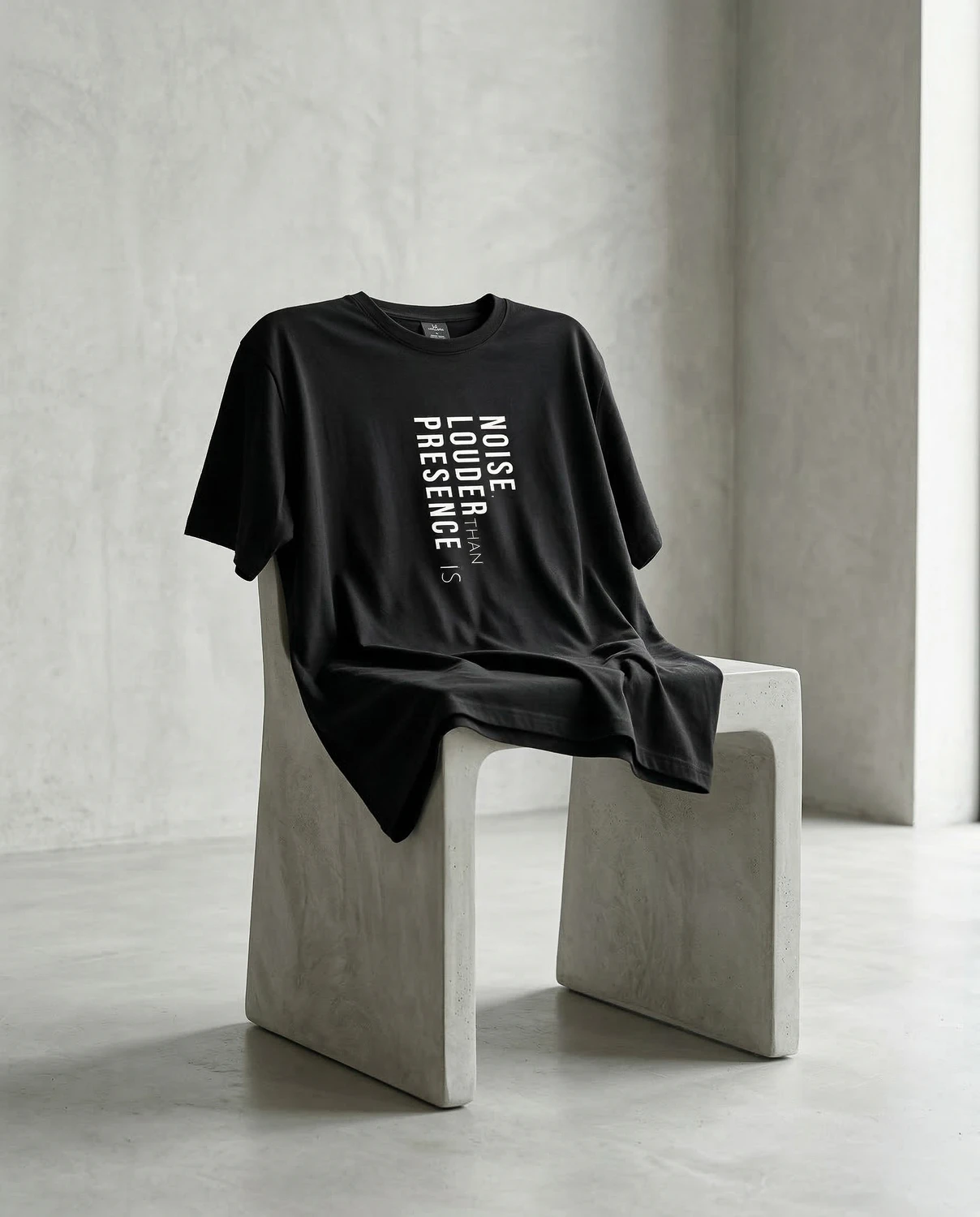
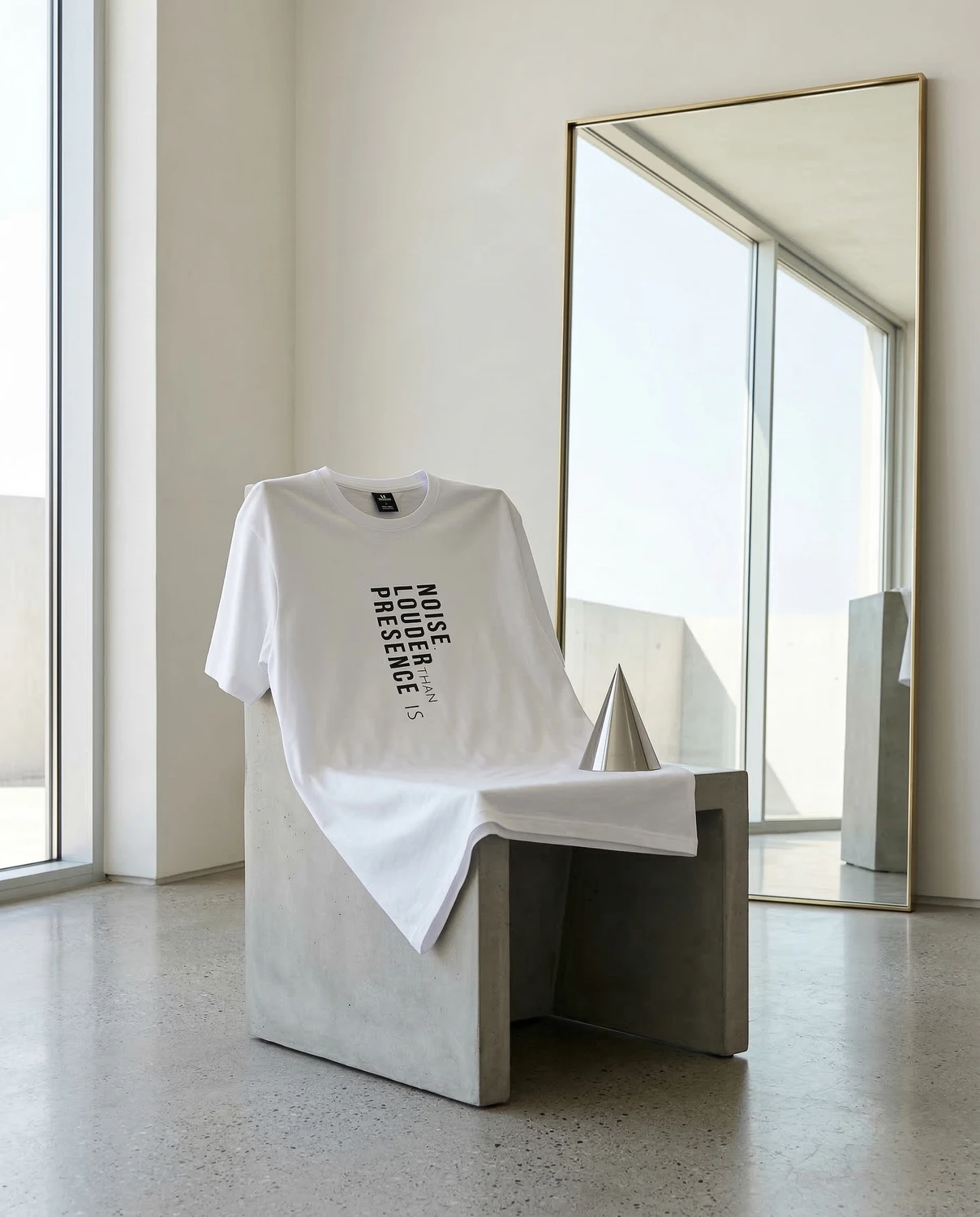
The answer came unexpectedly, through typography. “PRESENCE IS LOUDER THAN NOISE” is designed as a vertical composition, where the words do not run horizontally as usual, but build themselves up like a column. It’s a visual paradox: a sentence that speaks of silence, but whose form demands that you stop and read.
The manifesto page created for the Biennale opened up this idea further: noise demands attention, presence demands nothing. A silence where nothing demands, but where presence glows so strongly that even chaos must listen. The loudest truth is the one that has no voice.
Noise versus presence
We live in an age where everything is loud. The ad is loud. Social media is loud. Opinions are loud. Even silence has become something that needs to be performatively demonstrated, “look how consciously I am silent”.
But real presence is not a performance. This is not a meditation app or a mindfulness post. It’s something much simpler and much more difficult: it’s just being there without trying to prove anything.
I’ve been a photographer for over 18 years and one thing the camera has taught me is that the strongest shot is often the one with the least going on. One person on an empty street. A single ray of light in a dark room. Not because there is nothing there, but because there is only what matters.
I designed this shirt with the same logic.
Anatomy of Design
Vertical typography is a conscious choice. Most T-shirt text is horizontal because it’s easier to read. But Presence Is Louder Than Noise doesn’t want to be an easy read-it wants to be a stop. The vertical direction forces your eyes to move differently, more slowly. And this slowing down is the whole point.
Black fabric, white text, or white fabric, black text. There are no others. No graphics, no icon, no decoration. Only words that build form. Blacksunset’s aesthetic has always been this: if a design needs explanation, it doesn’t work. This design needs no explanation. He just stands.
Who wears it
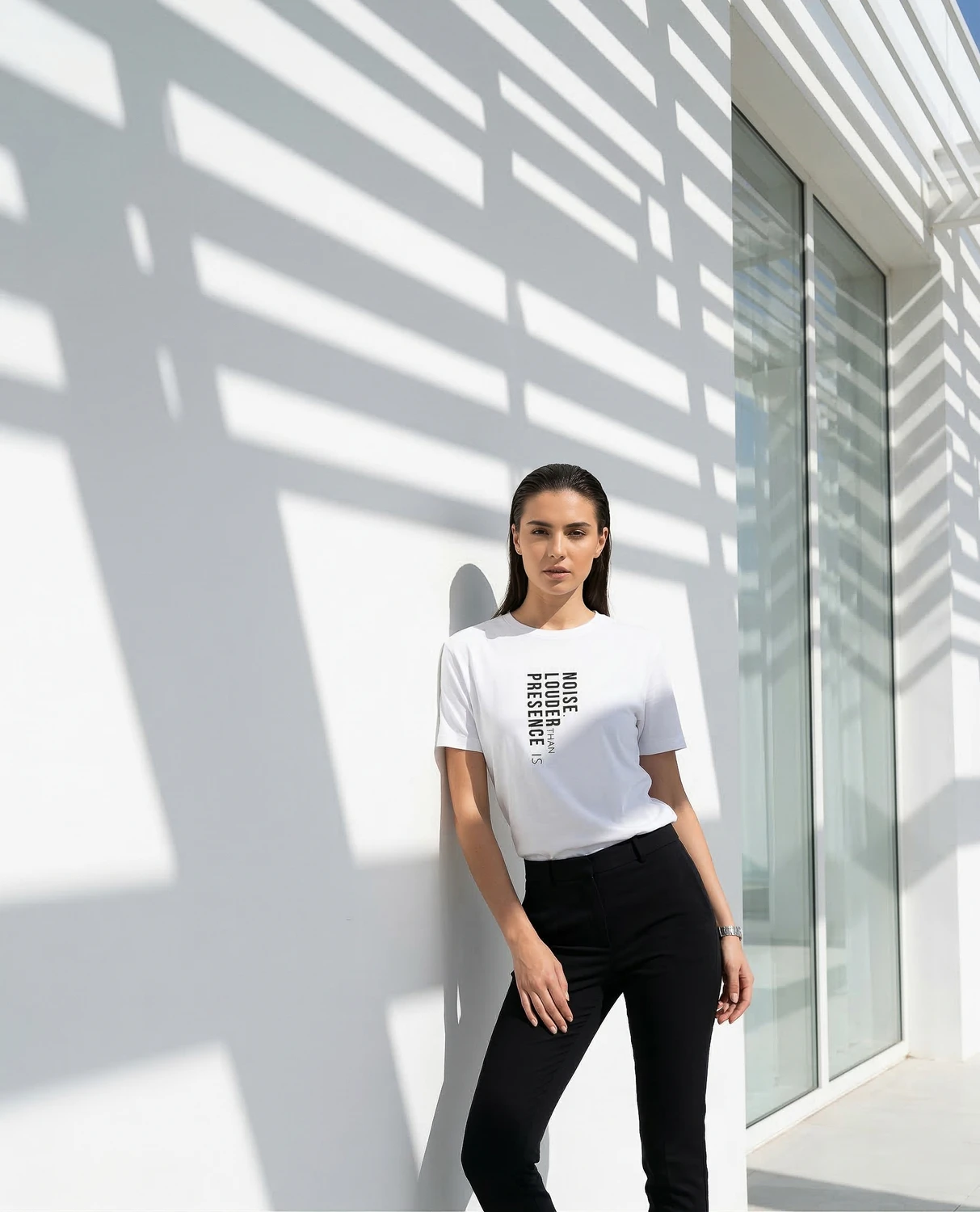
This shirt is for the person who realized a long time ago that you don’t have to be the loudest to be the most influential. Who knows that strength is not the tone of voice, but what remains when everything else falls silent.
It’s for the person who isn’t afraid of empty space in conversation. Who does not fill silence with noise. Who lets his nature speak.
And yes, it’s a bit ironic that such a message is written on a t-shirt that is visible and public by nature. But precisely in this irony lies the core of Shift Theory: a shift occurs when things are not quite what you expected.
Material and quality
100% combed ring-spun cotton, approx. 185 g/m². Unisex regular cut. Black or white. Sizes S to 2XL. Made to order, because we do not produce excess quantities. Price €35, free delivery from €50.
There is also a reflective design option (+€5), which means that the sentence becomes reflective in the dark. Silent during the day, luminous at night. It suits this design better than any other.

Context of Shift Theory
“Presence Is Louder Than Noise” is the third design I’m writing about on the Shift Theory Collection blog. The first, “What If It’s Not a T-Shirt?”, asked if a T-shirt is what it claims to be. The second, “Existing Not To Impress, But To Be,” was about validation culture fatigue. This third one adds the missing piece: when you’ve given up on impressing and ask things differently, what’s left? A presence remains. And that’s enough.
The entire Shift Theory booklet with visuals and thoughts for all ten designs can be downloaded from the product page.
References and links:
- Presence Is Louder Than Noise, on the product page
- What If It’s Not a T-Shirt?, on the product page
- Existing Not To Impress, But To Be, on the product page
- Not Here to Explain, on the product page
- Shift Theory Booklet (PDF)
- All Blacksunset t-shirts
- What If It’s Not a T-Shirt?, blog post
- Existing Not To Impress, But To Be, blog post